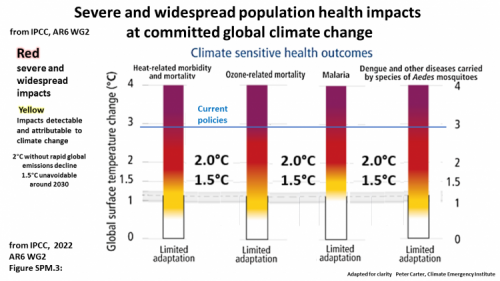
The IPCC 6th Assessment Report (AR6) represents the most comprehensive scientific assessment of climate change ever published. It confirms unprecedented atmospheric CO₂ concentration and rate of increase — the highest level in 14 million years, rising 10 times faster than at any time in the last 800,000 years.
IPCC 6th Assessment (AR6)
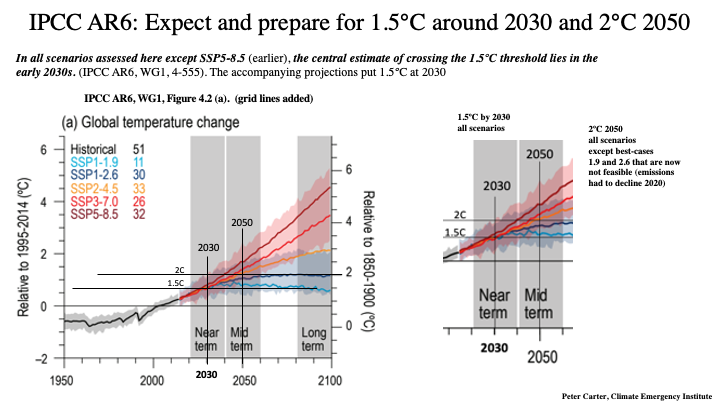
Global disastrous fixed 1.5°C 2030 or soon after and 2°C by 2050.
“In all mitigation scenarios, crossing the 1.5°C threshold lies in the early 2030s” 2°C is crossed by 2050 (IPCC AR6 WG1 Ch.4-555)
IPCC temperature increases are only to 2100. Warming continues 100s of years after 2100
Unprecedented atmospheric CO2 concentration and rate of increase
Highest level in 14 million years. Rate of increase 56 million year high
The rate at which CO2 has increased in the atmosphere during 1900–2019 is at least 10 times faster than at any other time during the last 800,000 years, and 4–5 times faster than during the last 56 million years (all IPCC AR6, WG1, incl. 5-676)
IPCC 6th Assessment (AR6)
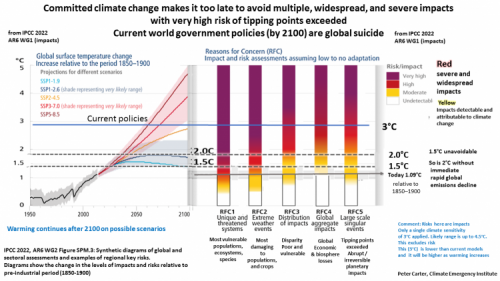
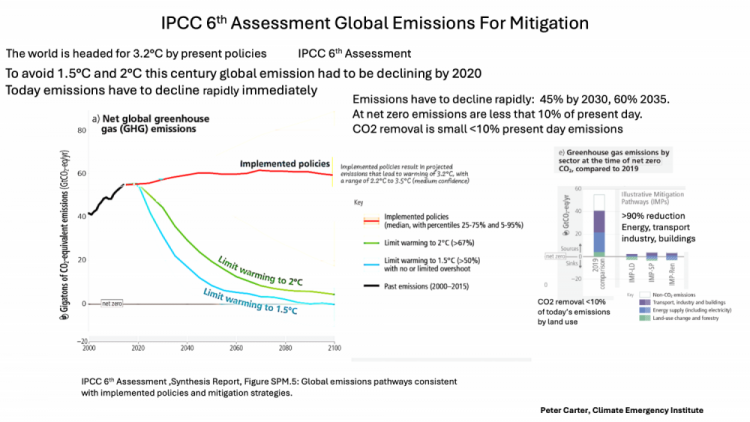
On Current policies Warming will be 3.2°C this century according to IPCC AR6, much higher after 2100
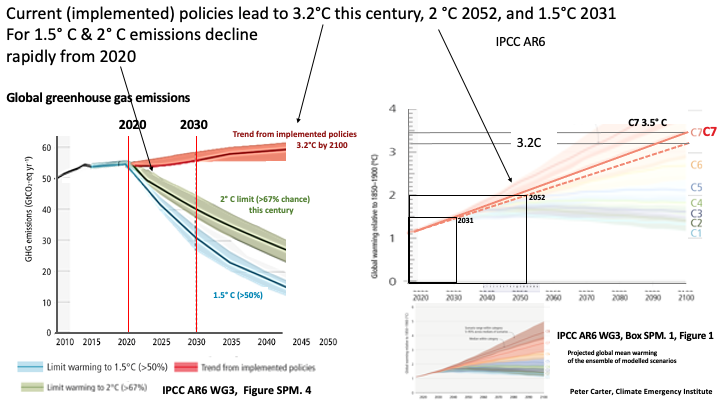
For 1.5°C & 2°C emissions had to be in decline by (2020-2025 t latest), with immediate action (IPCC AR6, WG3, SPM, B.1.)
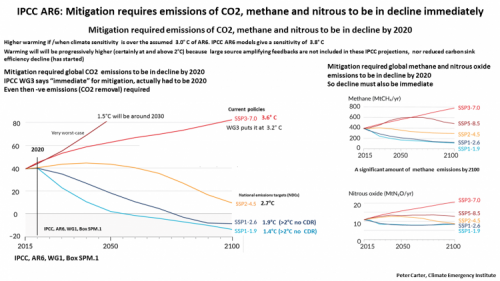
IPCC AR6 Global temperature increase projections
Unnoticed, 2023, 2024 and 2025 temperature increases were on the worst-case scenario, SSP5-8.5
Copernicus has put the average for the three years above 1.5°C
IPCC Reasons for Concern Risks/impacts
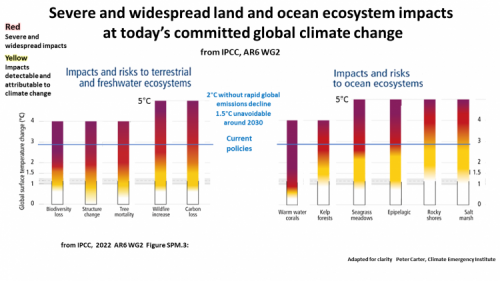
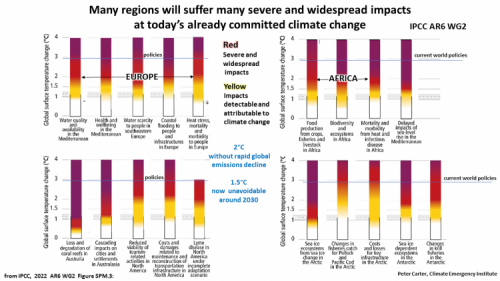
The ‘burning embers’ IPCC formulation of risks/impacts.
The global warming at which impacts occur in AR6 is much lower than the 2014 IPCC AR5, as research has found impacts occur at lower degrees.
The red zone is severe and widespread risk/impacts